Work package contributors: WP3, WP4, WP5
Pedestrian Level of Service (PLOS) and Bicycle Level of Service (BLOS) are assessments to evaluate the quality of walking and cycling infrastructures. Tools as PLOS and BLOS have evoluted to a more user-centered approach but they fail to align with 15mC principles such as proximity and accessibility. Adressing this gap was crucial to align with these principles
A review of existing PLOS and BLOS literature within the context of the 15-minute city made possible to identify the key broad constructs necessary to evaluate pedestrian and cycling infrastructures across urban contexts. For each constructs (6): indicators were identified and prioritised based on their frequency and relevance in literature (138 indicators). Those indicators were categorised into construct to form the "golden nuggets". A hierarchical and unified conceptual framework was developped.
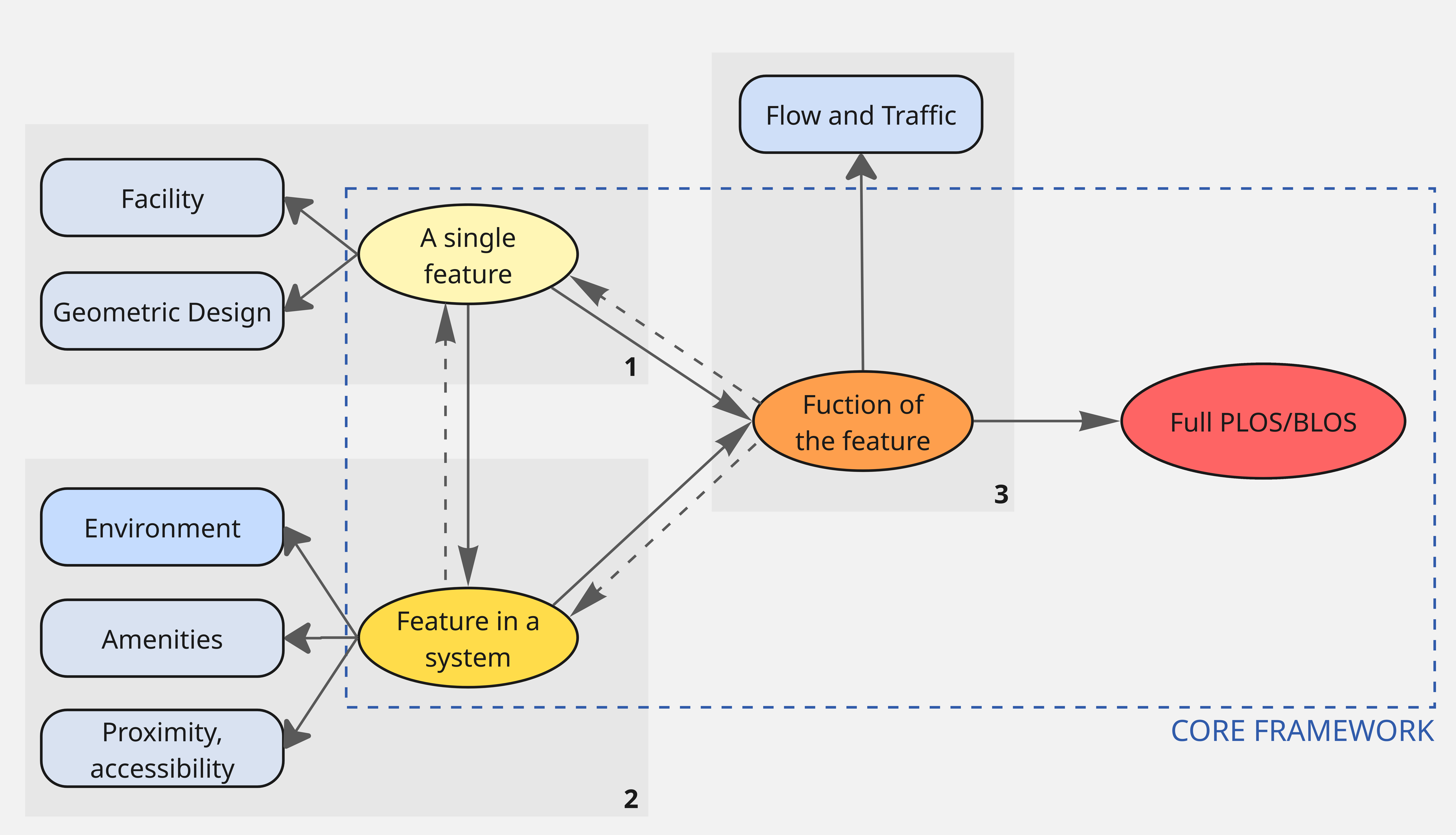
Indicators were integrated into a three-layered conceptual framework to capture the complexity of non motorised transport. The three-layered conceptual framework is scalable (micro and macro) and give a comprehensive perspective.
Maheshwari, R., Loidl, M., Khare, R., & Cools, M. (2025). Are we measuring what matters? A multilayered
framework evaluating active mobility infrastructure through PLOS, BLOS and 15 minute city principles.
Journal of Cycling and Micromobility Research, 6.
Read the article: https://doi.org/10.1016/j.jcmr.2025.100089
Work package contributors: WP4, WP6
Individual contributors: Ivana Paulusova, Fariya Sharmeen, Qian Wang. Department of Urban Planning and Environment, KTH Royal Institute of Technology, Stockholm (Sweden)
There is ambiguity how accessibility should be objectively measured. Perceived bikeability is a relevant but conceptually fragmented construct characterized by heterogeneous definitions and inconsistant implementations. To assess perceived bikeability, it is necessary to examine discrepancies between objective and perceived bikeability. The research brought an alternative approach by considering the same elements as objective measures but evaluated through the lens of individuals perceptions.
A literature review has focused on definitions and measurements. Many authors demonstrate robust links between perceived bikeability and cycling behaviour. Three categories were identified :
3 sources of mismatches
The research proposes an integrative conceptual framework that position perceived bikeability as a central component impacting cycling behaviour. Conceptual framework is built on literature review that synthethises empirically supported and hypothesized relationships between different components.
.jpg)
The components in figure are interconnected with direct and indirect effects on cycling behaviour and relative strengths of these effects. Objective bikeability provides the baseline physical context of conceptual model but characteristics such as population density, destination density, land-use mix... demonstrate less consistent associations with cycling outcomes. Individual socio-demographic characteristics generally exhibit weak but non-negligible associations with perceived bikeability but gender and age are highlighted. Individual attitudes, mobility resources and peer influence are more influential that socio-demographic attributes. Socio-cultural context such as policies, regulations, cultural norms have important role in shaping attitudes that influence individual behaviour.
Perceived accessibility scale (from Lätmann) is useful to start measuring perceived bikeability. But it is analytically limited because of its aggregated nature and the limited guidance it provides into the specific aspects of cycling accessibility that should be taken into account. To adress these shortcomings, the research propose to assess perceived bikeability by :
Drawing on Maslow's hierarchy of needs and the Capability approach, 4 core needs underlying perceived bikeability are proposed : access, safety, social support and excitement
→ Considering two gaps
→ Developing a multidimensional framework
coming soon
Work package contributors: WP5, WP3, WP4
→ 2 constrasting views of cities :
→ The difference between both is relevant for our position regarding urban digital twins:
→ The way to do this?
We propose a revised structure of mature digital twins:
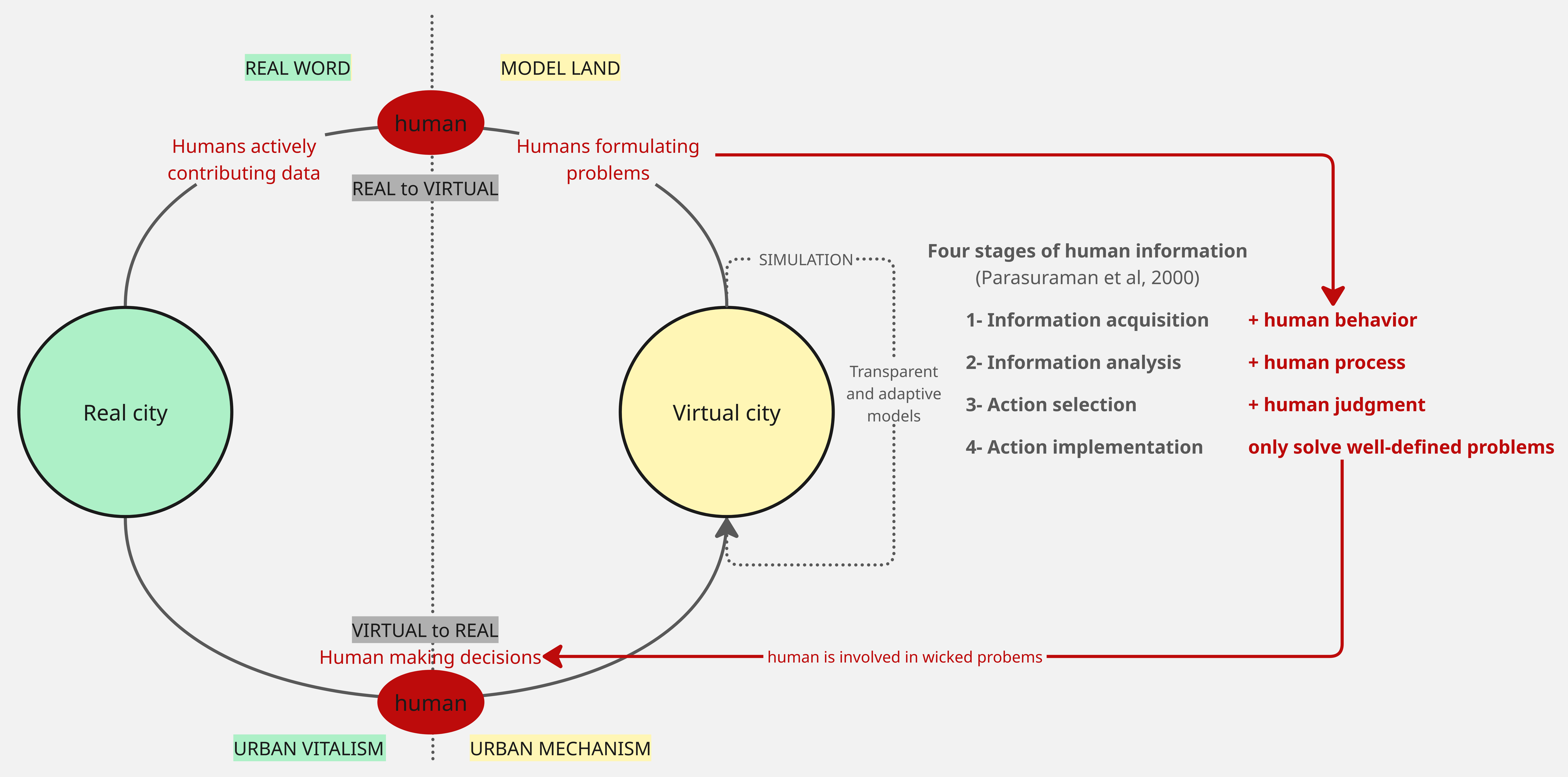
Van der Meer, L., Esterle, L., Cools, M., & Loidl, M. (2026). Cities aren’t rocket engines: the maturity of digital twins in human-centred urban planning.
International Journal of Digital Earth, 19(1)
Read the article: https://doi.org/10.1080/17538947.2026.2630452
Work package contributors: WP4
Issue: How citwin uses NetAScore
How to adress it:
C. Werner,R. Wendel, D. Kaziyeva, P. Stutz,L. Van der Meer, L. Effertz, B. Zagel, M. Loidl M. (2024). NetAScore: An open and extendible software for segment-scale bikeability and walkability.
Environment and Planning B: Urban Analytics and City Science, 52(1)
Read the article: https://doi.org/10.1177/23998083241293177
Work package contributors: all WP
On 27 April 2026, our partners had the opportunity to present the key progress updates and results of the project.